


Gas grills are becoming increasingly popular among grillers around the world. There are several reasons for this: the temperature in these grills is easy to control, it is immediately as needed; it is easy to increase and decrease; grills heat up much faster; there are no extraneous smells and smoke that occur when burning coal; barbecues have a large area; you can not only fry, but also smoke dishes in them.
Therefore, when considering the purchase of a gas grill, it is very important to know where to start. We invite you to familiarize yourself with one extremely significant indicator, which, as we notice, buyers pay very little attention to. And he is extremely important. Meet BTU.
BTU - What is it??
BTU is an English term British Thermal Unit abbreviation. It is quite an old unit of measurement, originating from the period of industrial breakthrough. So it is not surprising that it is measured quite practically (and in British terms):
1 BTU is the amount of heat required to raise the temperature of 1 pound (453.92 g) of water by 1 degree Fahrenheit. We can also convert BTU into a modern unit - days. 1 BTU = 1'055 J.
BTU is mostly used to measure the power of heat-generating, air-ventilating devices, and gas devices. In this case, if the device (grill) has 20'00 BTU, it means that it generates that much power in 1 hour.
It is necessary to evaluate the grill according to BTU, it is the most important indicator. The number of BTUs is expressed as how much heat your grill will generate with all burners on, operating at maximum capacity for 1 hour.
All manufacturers of gas grills, even if they are somewhat serious, will definitely indicate this number in the parameters of the grill. And if it is not named - do not doubt, it is hidden for a reason.
However, even if the BTU is listed, be aware that some manufacturers cheat and, to make it look more impressive, do not list the number of each burner, or add up the BTU of not only the internal burners of the grill, but also the side burners or the external ones. SIZZLE zones parameters. Therefore, reading more carefully is not only recommended, it is necessary.
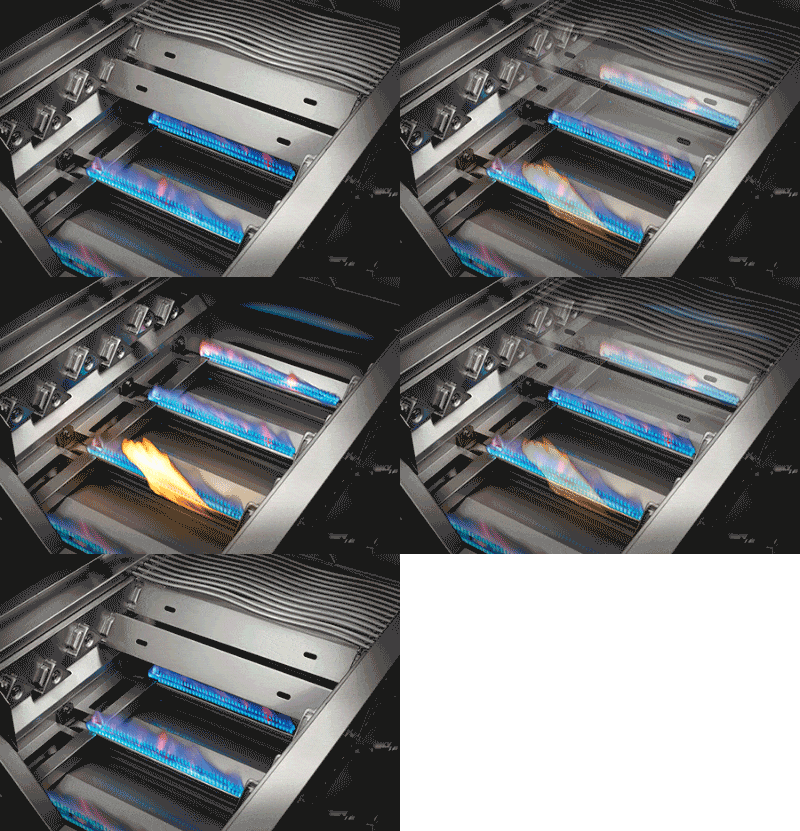
How many BTUs would be needed?
Since the main, internal area of the grill is mostly used for cooking, you will have to calculate how many BTUs per square centimeter of your grill grate area. Ideally, the BTU generated by the grill should be 12.5 - 15.5 per 1 square centimeter.
Let's calculate:
NAPOLEON Rogue 525 Gas Grill contains the following parameters:
BTU - 48'000; grill area - 73 x 45 cm (3'285 sq.cm).
Hence, 1 sq.cm. per BTU is:
48‘000 / 3‘285 = 14,61
The more BTUs the better?
Not quite true. The more BTUs your grill or stand-alone grill burner has, the more gas it will use when it's on max mode. Powerful burners are good, of course, especially when you want a perfectly seared steak or pizza. But after all, you will most likely cook them only in a certain area, and not in the whole (especially large) grill.
Therefore, our recommendation is to choose only gas grills whose burners can be switched on and off separately, independently of each other. Cheap variants of gas grills usually have a combustion system distributed over the entire area and there is no possibility to turn on only a part of it (after all, this boils down to the cost). In this case, although you save on the purchase of a grill, the savings are no longer on the grilling side - you are simply burning gas unnecessarily...
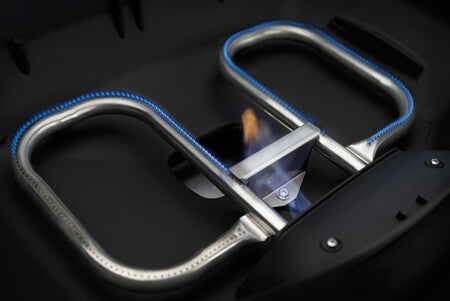
For this reason, one of the largest grill companies, NAPOLEON, was the first to offer an extremely popular and already copied solution - THE SIZZLE ZONE (). This is a separate, small zone on the side of the grill that heats up extremely quickly. The NAPOLEON sizzle zone can reach temperatures of up to 800 degrees! Cooking steaks, kebabs or other dishes that require a hot temperature here is not only much more efficient, but also faster and more convenient. A special patented technology allows for extremely high temperatures at minimal costs.
Grill volume and weight - why is it important?
BTUs are by no means everything that determines your grill's gas consumption and ability to reach high temperatures. It is no less important to consider other aspects as well.
Large internal volume of the grillhurray means that you create burners The BTU will need to heat all the air barbecues inside and metal its internal components, the bottom of the grill, the sides and the lid. So gera gas barbecues is are made of heavier, thicker, more durable materials and parts that will retain heat. It is not for nothing that manufacturers emphasize a thick or double grill cover, solid construction, metal thickness or materials.
Here, for example, is NAPOLEON PRO™ 500 gas grill have aluminum bottom and large volume. Due to proper structural design air flow movement and heat reflection to aluminum heats up pretty quickly, and the heat generated will remain inside.
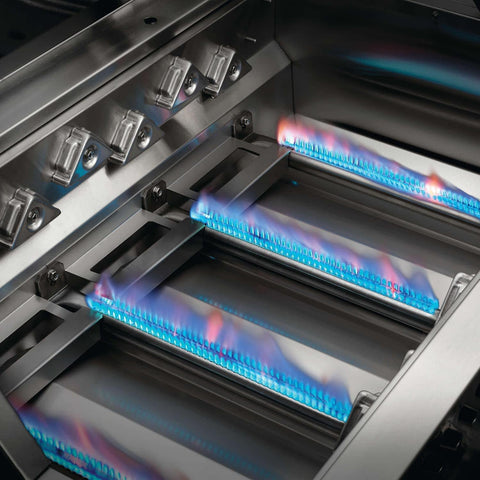
Even such a part of the grill as the grill will definitely contribute to the accumulation of heat. Thick stainless steel or cast iron grates will retain heat much longer than thin metal ones.
Therefore, when choosing a gas grill, check its weight - a very logical and correct decision.
Controlled airflow - what are we talking about?
Airflow movement is an important aspect of any grill. It affects optimal combustion. Properly constructed gas grills have openings that allow air flow to move from the bottom to the top and exit at specially designated locations.
Think about how your fireplace stack workss. You can have the grill with all the BTUs in the world, but if does not create good air flow inside the grill, your grill will not cook efficiently and will not be powerful.
It is no less important that the cavities for air supply and exit are very carefully thought out. They must allow the oxygen that is needed for gas combustion to enter and must allow it to leave, but in such a way that the grill is not cooled too much, as much heat as possible remains inside and a stable temperature is maintained.
You may also notice that on the grill grates is hotolder ones and coldolder ones places - that's a lot often seen when grilling with cheaper grills. Nevertheless, even the world's best gas grills can have airflow problems if the weather is extremely windy - by the way, the same applies to all types of grills in general.
Another reason why proper cavity design is important is the quality of your grilled food. If the fuel in the barbecue will not burn completely, it will not receive enough oxygen, the gas will not burn cleanly and extraneous combustion products will remain on your food. This is bad for both you and the environment. Such grills may not even create a stable temperature, not have enough power.